LipoD293™ DNA In Vitro Transfection Reagent
Description
By utilizing our innovative and proprietary lipid conjugation
technology, LipoD293™ (Ver. II) is specially designed and formulated by
adding proprietary enhancers for transfecting HEK293 cells and other
mammalian cells (Figure 1). As a 2nd generation liposome based DNA
transfection reagent, LipoD293™ (Ver. II) offers extremely high
transfection efficiencies for HEK293 related cells as well as many
mammalian cells with less cytotoxicity. LipoD293™ reagent (Ver. II),
upgraded from its previous version with refined chemistry, is 3~4 times
more efficient in gene delivery. LipoD293™ reagent (Ver. II), 1.0 ml,
is sufficient for ~666 transfections in 24 well plates or ~333
transfections in 6 well plates.
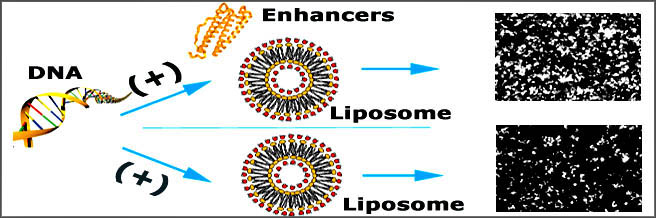
Figure 1. A Cartoon Showing LipoD293™ (Ver. II) Enhanced Gene
Delivery
Features
- Top choice for hard-to-transfect cells
- Exceptional high titers of virus production
- Equally good for very long DNAs (up to 180 kb)
- Equally good for suspension 293 cells (e.g., 293F, 293H, etc)
- High levels of recombinant protein production
- Presence of serum and antibiotics enhances efficiency on 293 cells
- Exceptional efficiency for both single DNA transfection and multi
DNAs co-transfection
- Very affordable
Storage Condition
Store at 4 °C. If stored properly, the product is stable for 12 months
or longer.
Comparisons of
Transfection Efficiency of LipoD293™ DNA In Vitro Transfection Reagent
(Ver. II) with Brand Name Products
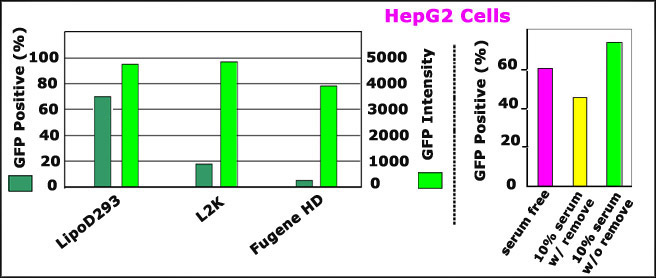
Comparison of transfection efficiency of LipoD293™ reagent (Ver. II)
vs. lipofectamine 2000 (L2K) and Fugene HD on HepG2 cells.
Right Panel: Comparison of transfection efficiency of LipoD293 (Ver.
II) with Lipofecatmine 2000 (L2K), and Fugene HD on HepG2 cells. GFP
DNA (pEGFP-N3) was transfected with different transfection reagents per
manufacturer's protocols to HepG2 cell (cultured on Collagen pretreated
dishes). GFP positive cell (%) and fluorescence intensity were detected
by passing through FACS 48 hours post transfection
Left Panel: presence of serum and antibiotics enhances LipoD293 (Ver.
II) efficiency on HepG2 cells. HepG2 cell (grown on collagen treated
dishes) was transfected with three different conditions-------serum and
antibiotics free, presence of 10% serum and antibiotics followed by
removal 5 hours post transfection and presence of 10% serum and
antibiotics without removal 5 hours post transfection.
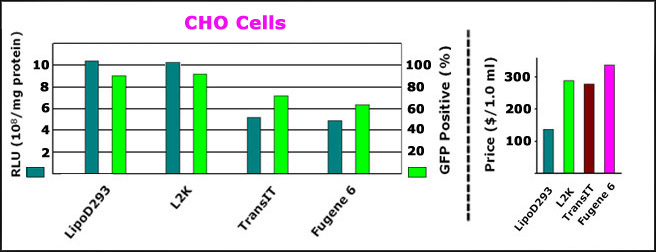
Comparison of transfection efficiency of LipoD293™ reagent (Ver. II)
vs. lipofectamine 2000 (L2K), TransIT and Fugene 6 on CHO cells.
Right Panel: Comparison of transfection efficiency of LipoD293
(Ver. II) with Lipofecatmine 2000 (L2K), TransIT and Fugene 6 on CHO
cells. DNAs encoding Renilla luciferase (phRL-CMV) and GFP (pEGFP-N3)
were transfected with different DNA transfection reagent per
manufacturer's protocols. Renilla luciferase activity and GFP
fluorescence were detected with Renilla Assay System and a Nikon
Eclipse fluorescent microcopy respectively 24 hours post transfection.
Left Panel: Comparison of price ($/1.0 ml vial) of LipoD293
versus those of Lipofecatmine 2000 (L2K), TransIT and Fugene 6. All the
prices were collected from the manufacturers' websites.
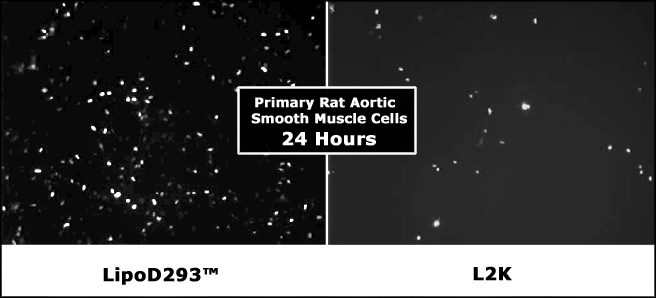
A comparison of transfection efficiency of LipoD293™ reagent with
lipofectamine 2000 (L2K) on a hard-to-transfect cell, primary rat
aortic smooth muscle cells. The rat aortic smooth muscle cells were
prepared and transfected with pEGFP-N3 by LipoD293™ reagent (left
panel) and Lipofecatmine 2000 (L2K, right panel) respectively per
manufacturers' protocols. The transfection efficiency was evaluated by
detecting GFP fluorescence with a Nikon Eclipse 2000 microscopy 24
hours post transfection. The above pictures were kindly provided by Dr.
Nickolai Dulin of Section of Pulmonary and Critical Care, University of
Chicago.
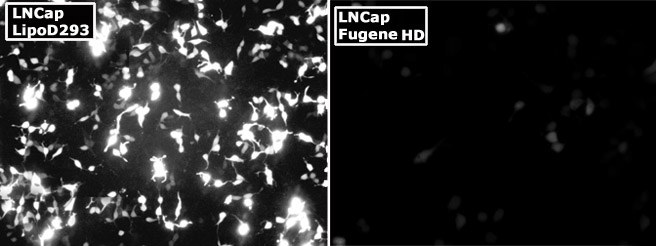
A comparison of transfection efficiency of LipoD293™ reagent with
Fugene HD on hard-to-transfect cell, LNCap cells. The LNCap cells
were grown as ATCC recommended procedures and co-transfected with
pBabe-hygro-SSeCKs (1.5ug) and pEGFP-N3 (0.5ug) per well (6 well plate)
LipoD293™ reagent (left panel) and Fugene HD (right panel) respectively
per manufacturers' protocols. The transfection efficiency was evaluated
by detecting GFP fluorescence with a Nikon Eclipse 2000 microscopy 24
hours post transfection. The above pictures were kindly provided by Dr.
Lyn Gao of Roswell Park Cancer Institute.
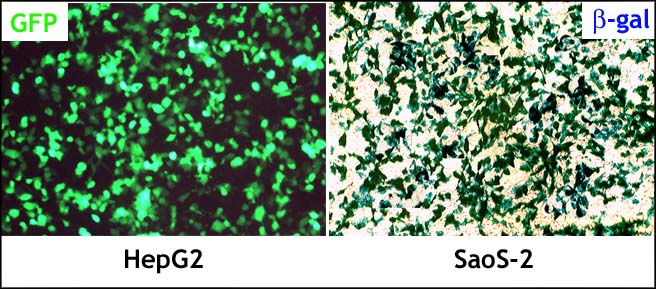
Two examples showing exceptional efficiency of LipoD293™ reagent on
hard-to-transfect cells like HepG2 and SaoS-2 cells. HepG2 and
SaoS-2 cells in 95% confluency were transfected with pEGFP-N3 and
pSV-?-galactosidase DNAs respectively in presence of serum/antibiotics.
The efficiency was checked 48 hours post transfection by Zeiss 510
Confocal Microscopy and ?-galactosidase staining kit respectively.
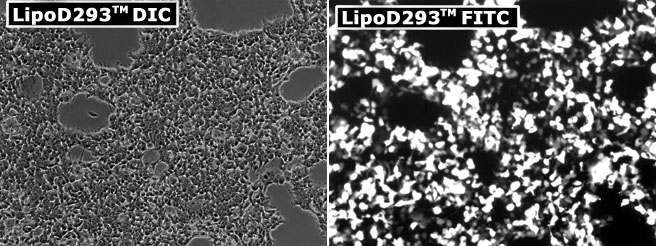
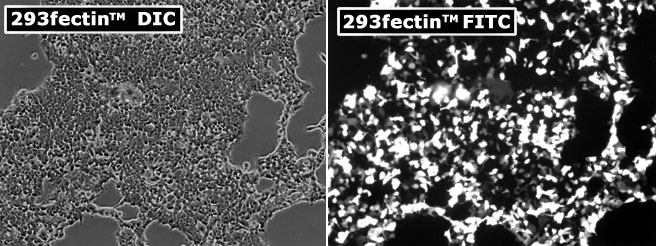
A comparison of transfection efficiency of LipoD293™ reagent with
293fectin on HEK293 cells. HEK293 cells transfected with pEGFP-C1
plasmid using LipoD293™ In Vitro DNA Transfection Reagent (Ver. II)
(upper panel) and the most popular brand product 293fectin™ of
Invitrogen (lower panel). The cells were visualized by Nikon Eclipse
Fluorescence microscope with DIC phase imaging (left panel) and FITC
imaging (right panel) 24 hours post-transfection.
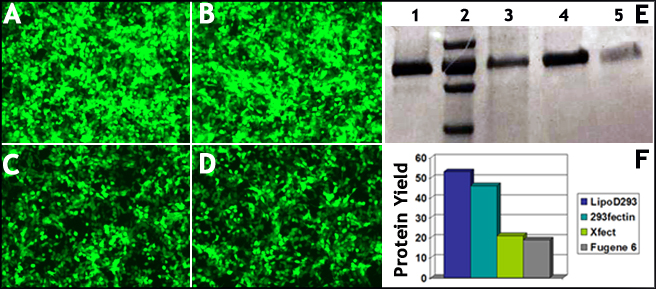
A comparison of LipoD293™ reagent vs.
293fectin, Xfect and Fugene 6 transfection reagents on protein production with suspension 293F cells. 30 mL of 293F cell
cultured in standard culture medium was transfected with pEGFP-6xHis plasmid using LipoD293™ In Vitro DNA Transfection Reagent (Ver. II)
(20 ug plasmid DNA), 293Fectin (30 ug plasmid DNA), Xfect (30 ug plasmid DNA) and Fugene 6 (30 ug plasmid DNA) per manufacturers'
standard transfection protocols. GFP fluorescence was visualized 48 hours
post transfection (left panel) with A for LipoD293, B for 293fectin, C for Xfect
and D for Fugene 6. The 6xHis tagged GFP protein was then
purified via Ni-NTA
affinity column. 5 ul of 1st elution fraction was resolved on SDS-PAGE
followed by Coomassie Brilliant Blue staining (right upper panel E) with the lane 1
for LipoD293, lane 2 for protein marker, lane 3 for Xfect, lane 4 for
293fectin and lane 5 for Fugene 6. The protein yield was quantified via
spectrometer (right lower panel F).
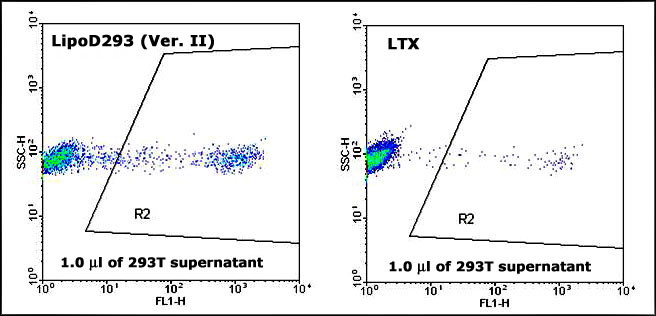
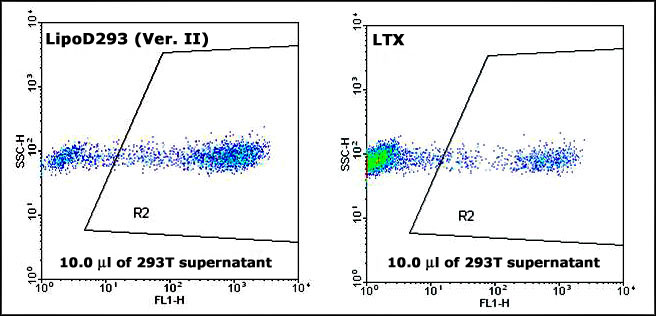
A comparison of LipoD293™ (Ver. II) and Lipofecatmine LTX (LTX) on
generation of Lentivirus (LV). Three cDNAs were co-transfected with
LipoD293™ (Ver. II) and Lipofectamine LTX (LTX) into 293FT cells. A GFP
vector, pHR-SIN-cppt-CMVEWP, was used to determine titer of LV. 1x10⁵
293F cells per well was plated in to a 24 well plate followed by
addition of different of amounts of the vector supernatant, 1
microliter (upper panel) and 10 microliters (lower panel) respectively.
5 days later, the cells was passed with FACS. The numbers at the upper
right corner indicate the percentage of transduced cells. The titers of
LV generated with LipoD293™ and L2K were quantified to be 8x10^6 and
3x10^6 tu/ml respectively
Technical Information & Datasheet
-
LipoD293™ (Ver. II) Reagent General Protocol
& Data Sheet

-
LipoD293™ (Ver. II) Reagent Short Protocol
-
LipoD293™ (Ver. II) Reagent Protocol for
Transfecting Suspension 293 and CHO Cells
-
LipoD293™ (Ver. II) Reagent for Lentivirus
Production
-
LipoD293™ (Ver. II) Reagent for rAAV Production
- Technical Note & Transfection Tips
To request a free trial sample, please
Create An Account with us to
enter your shipping address and email us at
order@signagen.com

Testimonials
I am absolutely thrilled with the LipoD293 transfection reagent! I
compared LipoD293 to Lipofectamine for transfection of plasmids to
generate viral pseudoparticles and WOW! I recovered 4 times more virus
using the LipoD293 reagent than Lipofectamine!! This is wonderful news
for me and my mentor as it means that I don't have to spend so much
time (and resources) on transfecting 293T cells to recover virus for in
vitro experiments. My mentor was also very happy that LipoD293 costs
much less than Lipofectamine!! We have already ordered 5 mls of
LipoD293 and I have now convinced my lab mates to switch to LipoD293
since I got such good results with it. Thanks for making such a great
product!
-------- Christy Lavine, Ph.D., Harvard University
I wanted to update you on the free sample of LipoD293 that you sent to
us. I recently transfected some Plat-E's side-by-side with
Lipofectamine 2000, and your product out-performed it!!! We are also
validating it with HeLa cells, but otherwise we are VERY happy with
what we have seen thus far! Thank you for sending us the free sample,
it definately made the SALE for us!
--------Catherine Gallo, Ph.D., University of Cincinnati
we have now tried the LipoD293 DNA In Vitro transfection reagent on
293FT cells. In the first flask we used the protocol by Invitrogen
provided in theVirapower box insert (Virapower, pBABE-GFP plasmid, plus
Lipofectamine). In the second flask we used LipoD293 (30 ul/6ml media)
with the same amounts of Virapower and plasmid as in the first flask.
The results were stunning:LipoD293 gave twice as many transformants as
Lipofectamine 2000...
-------- A Beta Tester from Wayne State University